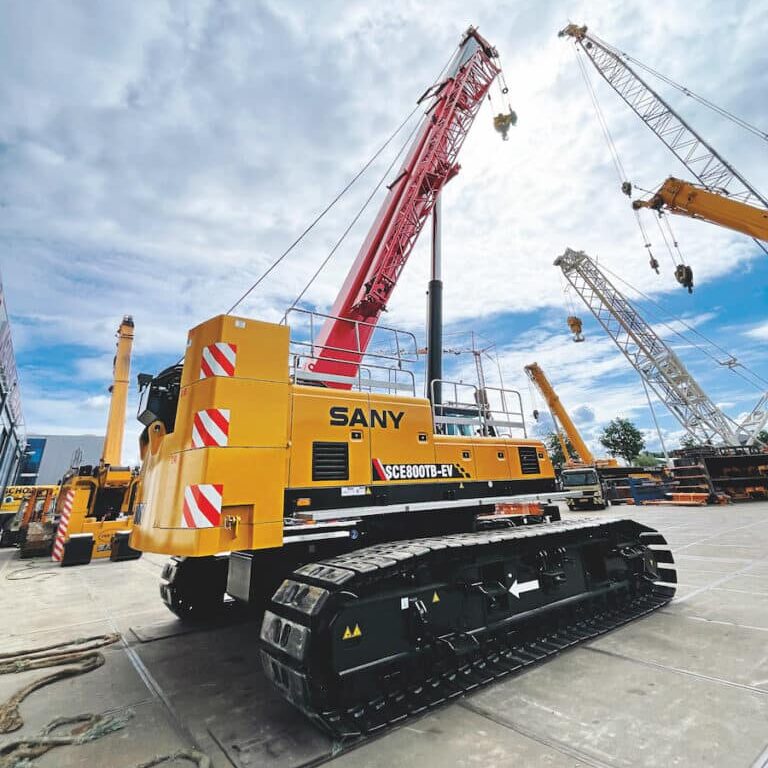
Tutt Bryant imported the SANY SCE800TB-EV, Australia’s first electric crawler crane. This move aligns with the growing demand for sustainable solutions and reflects the company’s commitment to supporting Australia’s transition toward a decarbonisation economy.
The SANY SCE800TB-EV reflects the commitment from Tutt Bryant and SANY to Environmental, Social, and Goverance (ESG) principles. As a responsible, visionary, and inspiring global enterprise, SANY supports the UN 2030 Agenda for Sustainable Development. SANY has launched more than 30 new energy products, covering three major energy supplement routes of pure electricity, electricity exchange, and hydrogen fuel.
Australia’s Decarbonisation Journey
Tutt Bryant is partnering with SANY and other key collaborators to reduce its carbon footprint and expand suitable options for customers through the Go Green initiative.
Beyond battery electric equipment, Tutt Bryant is also exploring alternative fuel sources such as renewable diesel, ethanol, and hydrogen..
On a practical level, Tutt Bryant has already implemented straightforward changes, such as upgrading to energy-efficient LED lighting in workshops and installing solar
PV systems at selected facilities. Additionally, Tutt Bryant continues its commitment to sustainability through an ongoing program of waste minimisation and recycling.
The expectations of the community are clear, and the growing popularity of electric vehicles among everyday Australians is a testament to the fact that the transition to a
decarbonised society is well underway.
SANY SCE800TB-EV Electric Crawler Crane
The SANY SCE800TB-EV electric crawler crane incorporates proven technology from CATL, the world’s largest battery manufacturer, featuring a cobalt-free LFP (lithium iron phosphate) battery.
Beyond fuel savings, the crane is powered by a Danfoss electric motor delivering 206kW of power and 1310Nm of torque, ensuring silent, emissions-free operation. These benefits are particularly valuable when working in confined spaces like tunnels or near residential and business areas, where noise and emissions can be a concern. Remarkably, all of these advantages come without compromising productivity when compared to traditional diesel-powered cranes.